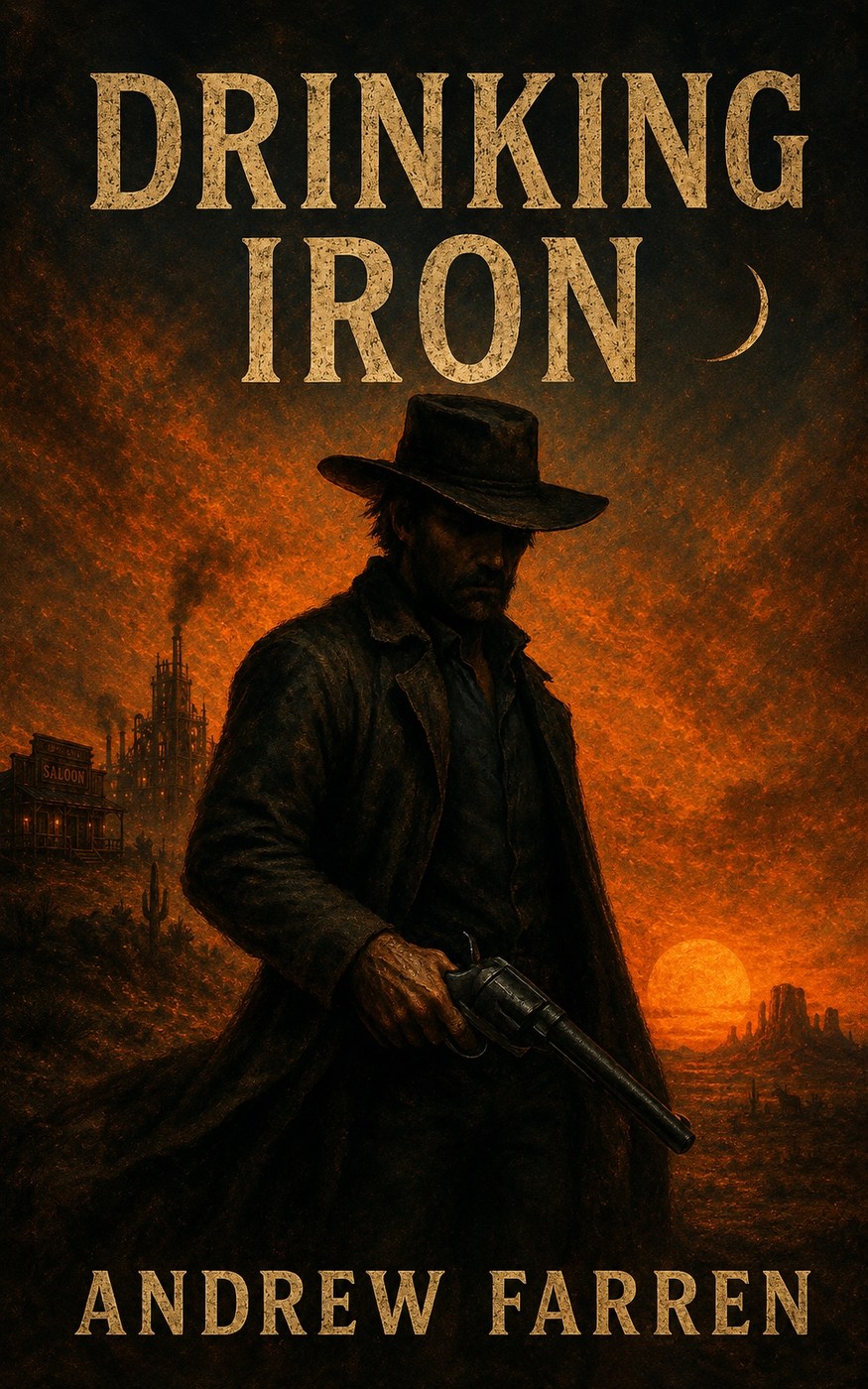
The Bartender’s Tale
By the time the boy shouldered his way through the batwing doors, the sun was already bleeding itself out across the horizon, staining the windows of the saloon the color of old wounds.
The place was nearly empty. Just dust turning lazy circles in the lantern light, a few crooked tables, and a long, scarred bar that had seen more years than most men in the territory. Bottles stood in uneven ranks behind it like a glass militia, catching the glow.
Behind the counter, the bartender polished a clean glass he didn’t need to polish. Old habit. His movements were slow, steady, quieter than whisperin’ sagebrush, his heavy mustache and lined face giving him the look of a man carved out of the same timber as the bar itself. The doors slapped shut behind the boy. The sound echoed loudly in the stillness.
He was young, that much was clear even through the dirt and blood. Couldn’t have seen twenty summers yet. His coat hung off him like it had been made for someone broader, someone older, and it was soaked dark at the side where his hand pressed flat. Each step he took left a small, wet mark on the warped floorboards. In his other hand, he held a pistol.
“Held” was generous. The barrel swung loose and wild, jittering more crooked than a broken-down mule every time his knees threatened to fold. His knuckles were bone-white on the grip, sweat and blood slicking the metal. The muzzle swept across the room, then crawled up the line of the bar, tracking the old man behind it. The bartender didn’t move.
He watched the boy for the span of a slow breath, taking in the gray tinge around his lips, the way his pupils flared, the tremor under the bravado. The smell of blood reached him a moment later, hot and metallic, threaded with the dust and old wood and stale whiskey that lived in the bones of the place.
“Mister,” the boy rasped, voice cracking around the word, “you’re gonna help me… or I’ll drop you where you stand.” The pistol wobbled toward the bartender’s chest as if to underline the point.
One of the lanterns near the door flickered, its flame dancing sideways in a breeze that hadn’t come from outside. The bartender set the glass down, careful, as if the only thing in the world he had to worry about was not chipping the rim. Then he straightened, wiped his hands on a cloth that had long ago given up on being white, and met the boy’s fever-bright stare. “Son,” he said, his voice low and dry as a creek bed in August, “you’re bleedin’ on my floor.”
The boy blinked, caught off guard by the answer. His arm dipped, then jerked back up, barrel skittering across the bartender’s shoulder, the wall of bottles, the empty length of the room. “I—I ain’t askin’,” the boy snapped. “You’re gonna patch me up, old man. Or I swear I’ll—”
“You’ll what?” The bartender tilted his head. “Fall over dramatic-like and haunt me with your sorry attempt at a threat?” The boy’s face flushed under the grime. “I’ll kill you.” There it was, the hard edge under the fear. Bullheaded, same as so many colts who thought the world started the day they first picked up iron.
The bartender let his gaze rest on the pistol. The muzzle shook a little more now, the boy’s arm tiring. That much blood loss would do it. He felt the weight of that gaze on the young man’s nerves, the way the air seemed to thicken around the two of them, the saloon narrowing down to one wounded pup and one old wolf who’d seen a great many things try to bare their teeth.
“You’re welcome to try,” the bartender said mildly. “But if you did have it in you, you’d have pulled that trigger already instead o’ talkin’ yourself up.” He stepped out from behind the bar. The boy flinched, gun jerking higher. “Now fix me up!”
“I heard you.” The bartender walked on, boots thumping steady against the boards. “Doesn’t change the fact you’re about three heartbeats from kissin’ these planks. You keep wavin’ that piece around, you’re liable to shoot the mirror, and then we’ll both be sorry.”
He stopped an arm’s length away, close enough now to see the ragged tear in the boy’s coat, the darker spill blooming beneath his fingers. Close enough to smell the copper tang heavy in the air, to see that the blood had soaked deep and fast… but the boy was still on his feet. Most men would’ve been face-down on the trail by now. Interesting.
The bartender lifted his hands, palms open, in a gesture that said he’d played this game before.
“I’m gonna take that gun,” he said. “Then I’m gonna sit you down, see what kind of hole some fool put in you, and pour whiskey into whichever end seems most urgent. You try to shoot me in the middle of all that, you’ll miss by a mile, and you’ll die cussin’ yourself for a poor marksman. Seems a waste.”
For a moment, the only sound was the boy’s ragged breathing and the soft buzz of a lazy fly circling the lantern. Then the boy’s arm sagged.
The pistol’s barrel dipped toward the floor, weight finally winning out over pride. He swayed, caught himself on the back of a nearby chair, and that simple effort tore a fresh line of pain across his face. “Fine,” he ground out, every letter an effort. “Fine. But if you try anythin’—”
“Son,” the bartender said, stepping in quick, hand closing over the pistol before the boy could change his mind, “if I wanted you dead, you’d already be quieter than a church mouse’s shadow.”
He twisted the gun from the boy’s grip with the ease of long practice, thumb checked the cylinder out of habit, then set the iron down on the bar a few feet away. The boy watched it go with the desperate focus of a drowning man staring at a floating plank.
“Over here,” the bartender said. He hooked an arm under the boy’s, guiding him toward a table near the wall. The kid was all sharp bones and stubbornness, leaning more than he probably realized. Each step pulled a soft grunt out of him. “Chair,” the old man said, nudging the back of one with his boot.
The boy dropped into it like his strings had been cut, one hand still clamped to his side. For a heartbeat he sat there, eyes closed, jaw clenched. Sweat beaded along his hairline despite the cooling air seeping through the cracked boards.
The bartender moved back behind the bar, not in retreat, just in a practiced circuit, and reached for a clean rag only he seemed to know existed among the stained clutter. He snagged a bottle of amber whiskey from the shelf, loosened the cork with a twist and pop, and set a heavy-bottomed glass on the counter.
He poured a short measure, the liquid catching the lantern light in a warm flare, then carried both rag and glass back to the table.
Without ceremony, he shoved the whiskey into the boy’s free hand. “Drink,” he said. “Slow. Don’t spill it. Good whiskey’s harder to come by than stray bullets in this town.”
The boy blinked down at the glass as if it were a rattlesnake that had forgotten to bite him. He lifted it with a faint tremor and took a tentative sip. The burn hit, and for a second it seemed to stun him out of his pain.
The bartender didn’t wait. He pulled the boy’s blood-slick fingers away from his side. That’s when the kid screamed.
It wasn’t the loudest the old man had heard in that room, but it had a good, raw edge to it. The wound underneath was bad, a furrow torn across the ribs, meat ripped, blood oozing in a steady sheet. Whatever had hit him wasn’t a bullet; had it gone any deeper, he’d have died then and there, and that slim, miserable mercy was the only reason he was still upright.
“Did you fight a bear?” The bartender pressed the folded rag hard against it. The boy arched, teeth bared, another strangled sound forcing its way between them. “Hurts, does it?” the bartender said, tone almost conversational. “Reckon that means you’re still on this side o’ the grave. Hold that there.”
He shifted the boy’s hand back over the cloth, guiding his fingers to keep the pressure. The kid was shaking now—not just from pain, but from the effort of staying awake. “Easy,” the old man said. “Breathe in, out. You pass out, you might wake up missin’ that arm. Doc in this town’s about as gentle as a bull on branding day.”
The boy tried to laugh and coughed instead. A little more blood flecked his lips than strictly comfortin’. “What… what’s it to you if I bleed out?” he managed, swallowing hard. “Could just kick me into the street. Sell my boots. Keep my gun.”
The bartender pulled out the chair opposite and sat down, the wood creaking under his weight. Up close, his eyes didn’t look quite as old as the rest of him. They were sharp, steady, taking measure.
“Could do all that,” he agreed. “But I get enough ghosts hangin’ ’round this place without invitin’ another one in just because I’m too lazy to grab a rag and a bottle.”
He leaned his forearms on the table. The lantern hanging over them threw a pool of gold light down, catching the rise and fall of the boy’s chest, the way the pulse leaped in his throat.
Outside, wind scraped along the warped boards of the saloon’s exterior, whispering like someone pacing just beyond the wall. “You ran far to get here,” the bartender said, not quite a question. The boy’s eyes flicked up, wary. “How’d you know?”
“You’ve got trail dust in places men don’t get from ridin’ between neighboring towns. And that rip in your side’s not from a rifle. And from here bears are a ways off.” He watched the boy’s reaction. The name of the animal wasn’t important yet. The fear was. “Doesn’t matter,” the kid muttered, gaze sliding away. “He missed.” The bartender made a small sound in his throat.
“If that’s what you wanna call it.” For a moment, silence settled between them, comfortable as an old coat to the bartender, raw and too heavy for the boy. The kid took another sip of whiskey, hand shaking less now, the drink’s warmth fighting the cold creep of blood loss.
“You ain’t… scared of much, are you, old man?” the boy asked after a bit, trying for bravado and only half getting there. The bartender’s mouth twitched. “I’ve lived long enough,” he said, “to see worse than some bullheaded pup pointin’ iron at my heart with his arm shakin’ like whisperin’ sagebrush in a summer storm.”
He let his gaze drift to the boy’s face, studying it in a way that made the kid fidget. There was something there. A sharpness at the angles. A familiar set around the eyes. Like a tune he hadn’t heard in years, but still knew the shape of. “Heard that line before,” the boy said, forcing a grin. “Old timers talk big until it’s their blood on the floor.”
“Maybe,” the bartender allowed. “But here you are, and here I am, and only one of us is leakin’ like a busted canteen.” The boy tried to answer, but his words tangled together, the edges of his consciousness fraying. His head dipped, then jerked back up.
“Don’t sleep just yet,” the bartender said. “You drift off too soon, and I’ll have to work twice as hard to drag you back.” The kid swallowed, blinking sand from his eyelashes. “Why help me?” he asked, quieter now. “You don’t know me.”
The old man thought about that. The lantern flame jumped once, long and thin, shadow stretching across the boy’s face. Outside, somewhere down the empty street, a dog barked once and fell silent. The air had that taste it got before a storm—not of rain, but of something waiting.
“Truth is,” the bartender said at last, “you remind me of another fool once came through another old saloon like this’n in worse shape than you. Same kind of look in his eye. Same stubborn tilt to his chin. Same idiot way of pointin’ a gun around like it was an extra finger instead of somethin’ that kills.”
The boy’s gaze sharpened through the haze. “Yeah?” he asked. “What happened to him?” The bartender watched him a beat too long. Old memory ghosted over his features, softening lines that didn’t soften often.
“Depends who you ask,” he said. “Some’ll tell you he became a hero. Some’ll swear he was a devil straight outta the badlands. Me, I figure the truth sits somewhere in that dust between.” He reached for the bottle, topped off the boy’s glass by a finger, then poured a smaller measure into one for himself. The whiskey caught the light like desert fire.
The bartender lifted his glass, turned it once between his fingers, and stared into the amber as if the past might be floating around in there, waiting to be poured out. “Son,” he said quietly, “he weren’t born a killer.” He tipped the whiskey back, throat working, set the empty glass down with a soft click that seemed to echo louder than it had any right to.
“But somethin’ followed him out of the badlands that made him one.” The boy shivered, though the room was not cold. The wind outside rose and fell as a distant crowd whispered a name neither of them had spoken yet.
“What was his name?” the boy asked, voice barely above a breath. The bartender’s gaze shifted past him, to the far wall where the lamplight pooled and shadows pressed close. For a moment, he looked every one of his years, and a great many more.
“Lucian Crowe,” he said. The name hung in the air between them like gun smoke. The boy’s fingers tightened over the blood-soaked rag at his side. His eyes, already wide, seemed to widen further.
“You mean… the Crowe? The outlaw?” “I mean the man,” the bartender said. “The outlaw part came later.” He leaned back, chair creaking, one hand resting on the table, the other idly turning the empty glass in slow circles.
“You sit there. Keep holdin’ that cloth. Let the whiskey do its work and the bleedin’ slow. I’ll see if I can’t keep you on this side o’ the veil a little longer.”
He glanced once toward the dark windows, as if checking that whatever listened out there was, for the moment, content to stay where it was.
“And while we wait,” he went on, voice dropping into the cadence of a man who’d told this story to himself more times than he’d ever told it aloud, “I’ll tell you how it started. Not the way the songs do, all polished up and pretty. The real way. Back when he was just a boy like you, and the world first decided it wanted a taste of his blood.”
The lantern sputtered, then steadied. The bartender folded his hands, the faintest sigh leaving him. “It began,” he said, “in a place colder than any home’s got a right to be. A house full o’ children and no real souls to care for ’em. Just steel, and gears, and the hum of machines that didn’t know the difference between keepin’ a body alive and raisin’ a child.”
His eyes, for an instant, seemed far away, seeing not the boy in front of him but some younger ghost, some older night.
“That’s where Lucian Crowe learned the sound of his own heart against the dark. Before the badlands. Before the blood. Before the iron started drinkin’ for him.”
He looked back at the boy, anchoring himself in the now. “You ready to hear it?” The kid swallowed, winced, but nodded. The bartender’s mouth curved, not quite a smile, not quite a grimace, more like a man barin’ his teeth at memory.
“Then listen close,” he said. “’Cause this here’s a tale the desert itself remembers. And it all starts with a boy cursed long before he knew what was walkin’ beside him.” And as the wind scratched softly at the walls and the lantern’s flame bowed to some unseen breath, the bartender began to speak of Lucian Crowe.
End of sample.
The story continues in Chapter One: The Clank-House.